
Room Ideas
Read guide
Wallpaper for small spaces
Small powder rooms, hallways, and entryways are where bold wallpaper patterns make the biggest statement without overwhelming a home.
New York Service Area
RCP Wallpaper takes on walk-ups, elevator buildings, and co-op boards as part of the job, not an obstacle to it.
5.0★
Average across 131 Google reviews, and still climbing.
10+
Years hanging wallpaper, so the awkward walls aren't a first attempt.
All types
Grasscloth, vinyl, fabric, murals, peel and stick — every style and budget.
What we do
What we hang
Grasscloth does not behave like vinyl, a mural does not behave like a repeat pattern, and silk punishes a mistake that a peel-and-stick panel would forgive. In pre-war apartments there is a second variable on top of that — plaster moves differently than drywall, and the material has to be chosen for the wall it is actually going on.
Sisal, jute and hemp bonded to a paper backing. There is no pattern repeat to line up, so the craft is in the sequencing: panels are reversed to even out the natural shading between rolls, and paste never reaches the face — on grasscloth a smudge does not clean off.
Numbered panels that form one image. The wall gets measured and checked for square before the order goes in, because a mural is cut to your wall specifically. Half an inch of drift across six panels is visible from the doorway.
Linen, silk and paper-backed textiles are the least forgiving surfaces in the trade. They go over a liner where the wall calls for it, and the seams are double-cut so the weave reads continuous instead of stopping at every panel.
Type II vinyl for corridors, lobbies and hospitality — the weight that survives carts, cleaning crews and daily traffic. Double-cut seams and the correct primer are what keep the edges from lifting a couple of years in.
The papers interior designers specify, where a single roll can cost more than the labor to hang it. Most are non-woven: they hang paste-the-wall and strip dry years later, which is the difference between a repaint and a drywall repair.
Removable panels for rentals, nurseries and anything meant to change in a few years. Easy to underestimate: the adhesive telegraphs every bump underneath, so the wall prep matters more here than on a traditional paper, not less.
Working with an interior designer or supplying your own paper? Send the spec sheet with your quote request — the material decides the prep, the adhesive and the seam method.
What changes in a walk-up or a co-op
A single-family house and a Manhattan fourth-floor walk-up don't run the same way, so the prep starts before anyone opens a roll of paper.
Walk-ups and elevator buildings
Materials and tools get sized for the trip up, whether that's four flights of stairs or a service elevator with a reserved window.
Co-op and condo board paperwork
Certificates of insurance and alteration agreement paperwork are handled ahead of the install date, not scrambled together the morning of.
Older plaster and pre-war walls
Plaster walls in pre-war buildings crack and flex differently than drywall, so prep gets adjusted room by room instead of applying one standard approach.
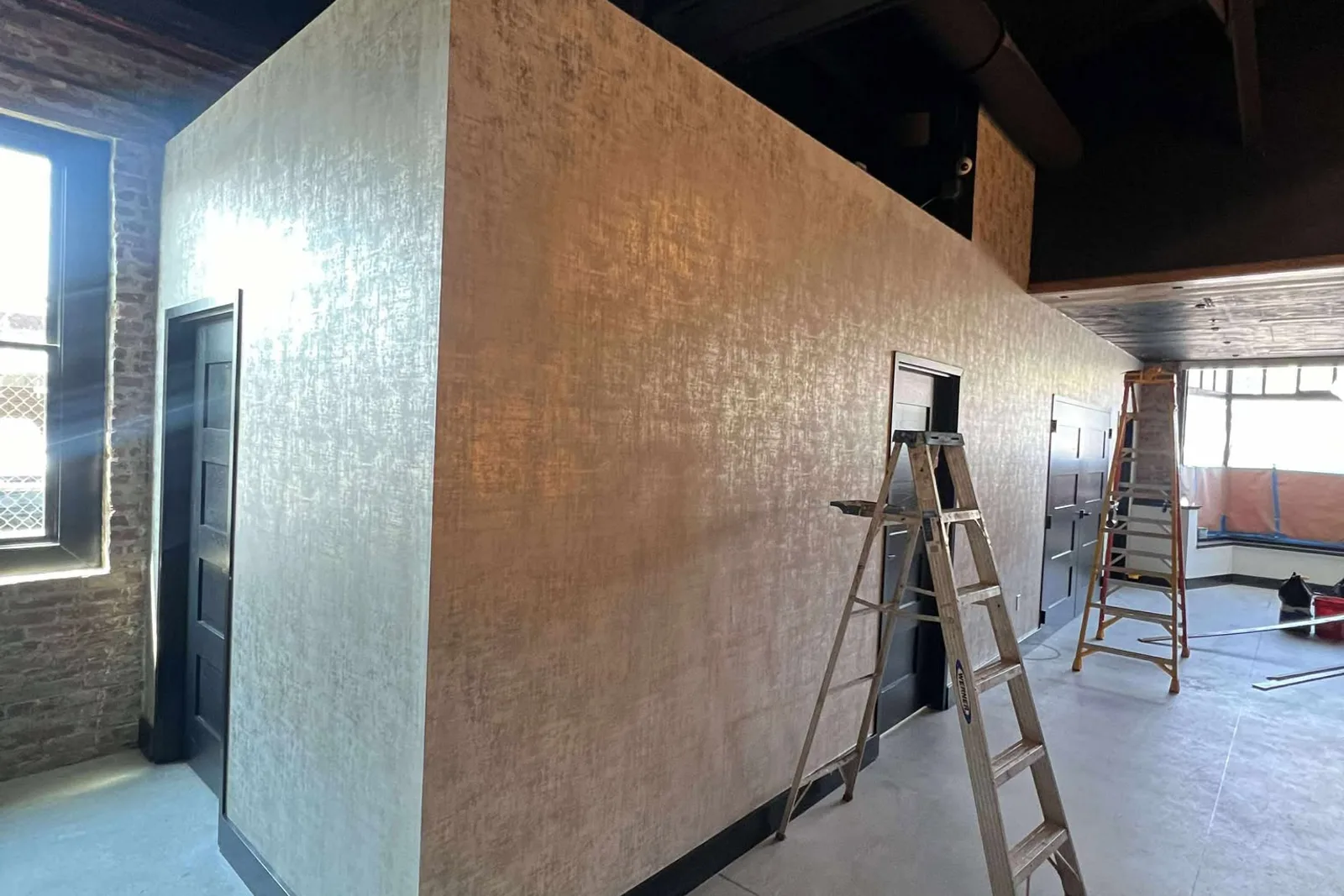
Commercial & residential
Scheduled around building rules, not the other way around
Before the building lets anyone in
In most New York buildings this is not a preference, it is the condition for getting through the door. Certificates of insurance naming the building and the managing agent go to management ahead of the install date, along with whatever the alteration agreement asks for.
Registered to work in New Jersey, residential and commercial.
General liability coverage. Certificates of insurance available on request.
The crew is covered, so a job in your home or building is not your exposure.
Wallpaper only — not a sideline of a painting business.
Real reviews
Real jobs, real walls
Manhattan walk-ups, elevator buildings, and full commercial buildouts. Pick a thumbnail to see it larger, and click the large photo to open it full screen.
1 / 3 · 12 photos
On-site footage
The part nobody photographs
A wallpaper job is judged the day it finishes and again five years later, and those two verdicts are decided by different things. The first is the pattern. The second is everything that happened to the wall before the paper touched it — which in a pre-war apartment usually means dealing with plaster that has been patched by four people before you.
Old paper comes off, holes and cracks are filled and sanded flat, and the wall gets a wallcovering primer — not the leftover paint primer. That primer is what lets a panel slide into position while the paste is still wet, and what lets the paper strip off cleanly years later without tearing the drywall face. Textured walls get skim-coated or lined first, because texture reads straight through the finished paper.
Every roll is checked for match type — straight, half-drop or random — and the vertical repeat is measured before the first cut, so the pattern is not discovered short halfway up a wall. The first panel goes to a plumb line, never to the corner, because no corner in a real house is plumb. Where the pattern has to break, the break lands where the eye does not travel.
Seams are butted, never overlapped, and double-cut on vinyl and textiles so the two edges meet exactly instead of shadowing. Paste that reaches the surface is cleaned while it is still wet. Corners are cut and restarted on a fresh plumb line rather than wrapped around — wrapping a corner is what sends a pattern running downhill across the rest of the room.
Simple, start to finish
Send the quick form with your building's address and floor — that's enough to start scoping the job. Prefer to talk? Call or text (862) 235-9269.
We review the space, note elevator access or stairwell width, and confirm the price before any work starts. Certificates of insurance and any board or alteration paperwork get sorted in the same step, ahead of the install date.
The crew works within the building's access windows, protects hallways and floors on the way in, and clears out once the last seam is set.
Ready to get your building's walls done right?
Where we work
The crew takes on residential and commercial jobs throughout the New York service area, from Manhattan walk-ups to full commercial buildouts.
Got questions?
Yes, certificates of insurance and any alteration agreement details get handled before the install date. Let the front desk or management office know a contractor is coming, and the paperwork side stays out of your hands.
Yes, walk-ups are common in the New York service area, and materials get carried up accordingly. It's worth mentioning the floor and any tight stairwells when requesting a quote, so the visit gets planned around it.
Often yes, once the plaster is checked for cracks and loose sections. Older walls sometimes need a skim coat or liner paper first, which gets sorted out during the on-site visit rather than guessed at over the phone.
Yes, evening and off-hours scheduling is standard for offices, restaurants, and retail spaces that can't have a crew in during business hours. Building access rules and freight elevator windows get confirmed ahead of time.
Pricing depends on room size, ceiling height, wall condition, and building access. Rafael visits in person, measures the exact space, and gives you a guaranteed number before any work begins.
Coverage across the New York service area is booked case by case. Call or text (862) 235-9269 to confirm your building is within reach before scheduling a visit.
From the field
Small powder rooms, hallways, and entryways are where bold wallpaper patterns make the biggest statement without overwhelming a home.
Simple cleaning techniques, moisture prevention tips, and routine care that keeps vinyl, grasscloth, and standard papers looking fresh for years.
Why hanging wallpaper directly over texture causes visible bumps, and how skim-coating and liners create the smooth foundation every install needs.