New Jersey · High Walls & Stairwells
Staircase wallpaper installation in New Jersey for the wall everyone sees from the front door
RCP Wallpaper handles staircase wallpaper installation in New Jersey on walls that most homeowners wouldn't attempt themselves.
Why choose RCP Wallpaper
5.0 stars across 131 Google reviews
Reviewers keep naming the same things: clean seams, patterns that line up, and a space left tidy. The average has held at a perfect 5.0.
We see the job before we quote it
Your quote is priced on the actual room and the material you pick, not a rough guess. You get a number based on your actual stairwell, not a phone-call estimate.
Patterns that actually match
Seams disappear and patterns line up, even across a wall two stories tall. Clients notice, and they say so in their reviews.
Built for height
The tallest wall in the house, done without a seam out of place
A stairwell often means working on a ladder or scaffold for hours at a height most people aren't equipped to handle safely. That's on top of the pattern-matching challenge — a single sloped wall running the height of two floors leaves no room for the drift a DIY job usually produces.
Wallpaper stair risers is the natural extension of a stair wall project, since both surfaces are easy to pair in the same visit.
Homeowners refreshing the whole entryway sometimes carry the same material into living room wallpaper too, if the two spaces are visually connected.
What's included
Height, angles, and no room for error
A staircase wallpaper installation in New Jersey covers the tallest wall in most homes, and it is the one that gets seen from three floors at once.
Two-story stairwells mean scaffolding or specialized ladders, and drops long enough that a small misalignment at the top becomes a visible gap at the bottom. The angle where the wall follows the stairs is the part that separates a clean job from an obvious one.
- Scaffolding or ladders sized for the stairwell
- Long drops aligned top to bottom
- Angled cuts along the stair line finished clean
- Full-height patterns planned before the first drop
What goes on the wall
Materials for a wall seen from three heights
A stairwell wall is viewed from the bottom, the landing and the top, so the pattern is read at three different angles and any drift shows in all three.
Wall murals and panel sets
Numbered panels that form one image. The wall gets measured and checked for square before the order goes in, because a mural is cut to your wall specifically. Half an inch of drift across six panels is visible from the doorway.
Designer and non-woven papers
The papers interior designers specify, where a single roll can cost more than the labor to hang it. Most are non-woven: they hang paste-the-wall and strip dry years later, which is the difference between a repaint and a drywall repair.
Grasscloth and natural fibers
Sisal, jute and hemp bonded to a paper backing. There is no pattern repeat to line up, so the craft is in the sequencing: panels are reversed to even out the natural shading between rolls, and paste never reaches the face — on grasscloth a smudge does not clean off.
How the work is done
Wall preparation, pattern alignment, and seams
The pattern is what gets noticed on day one. These three stages are what the wall still looks like years later, and they are the ones a cheap quote is usually leaving out.
Wall preparation
Old paper comes off, holes and cracks are filled and sanded flat, and the wall gets a wallcovering primer — not the leftover paint primer. That primer is what lets a panel slide into position while the paste is still wet, and what lets the paper strip off cleanly years later without tearing the drywall face. Textured walls get skim-coated or lined first, because texture reads straight through the finished paper.
Pattern alignment
Every roll is checked for match type — straight, half-drop or random — and the vertical repeat is measured before the first cut, so the pattern is not discovered short halfway up a wall. The first panel goes to a plumb line, never to the corner, because no corner in a real house is plumb. Where the pattern has to break, the break lands where the eye does not travel.
Seam finishing
Seams are butted, never overlapped, and double-cut on vinyl and textiles so the two edges meet exactly instead of shadowing. Paste that reaches the surface is cleaned while it is still wet. Corners are cut and restarted on a fresh plumb line rather than wrapped around — wrapping a corner is what sends a pattern running downhill across the rest of the room.
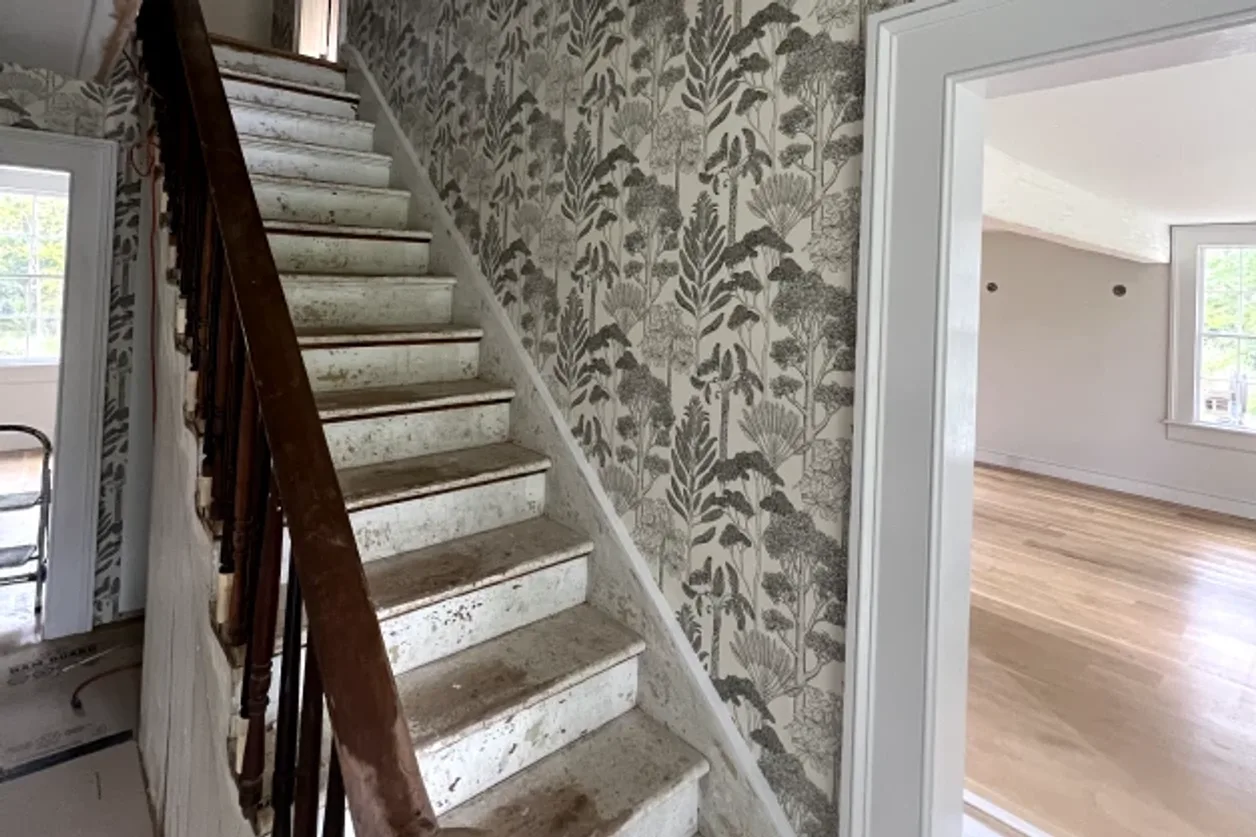
A stairwell is the one wall in the house seen from three heights at once. Panels are cut to the rake of the stairs and hung from staging, and the plumb line matters more here than anywhere — a stair wall shows drift instantly.
Before you book anyone
Licensed, insured, and covered
Certificates go out before the job starts, and straight to building management when one is required. More about the company.
Simple, start to finish
How it works
Request your free quote
Send the quick form with a few details about your staircase — it takes a minute. Prefer to talk? Call or text (862) 235-9269.
Scope and quote
We review the wall height and angles, talk through material options, and confirm the price before any work starts.
Professional installation
The crew installs, keeps your space covered while they work, and cleans up before they leave.
Why hire us
Why hire RCP Wallpaper for staircase wallpaper installation in New Jersey
A sloped, two-story wall is one of the least forgiving surfaces to work on. Any drift in the pattern becomes obvious from the bottom of the stairs looking up, and the height alone rules out most homeowners attempting it without the right equipment. The crew brings the ladders, the technique, and the patience the job actually requires.
Every quote is priced on the real room, never a flat rate. Ceiling height, the number of flights, and how the wall angles all change the plan, so an accurate number means seeing the stairwell first.
Questions
Frequently asked questions
Why is stair wallpaper harder than a regular wall?
The height and the sloped surface make it much less forgiving. A pattern drift that would barely register on a flat wall becomes obvious across two stories, and reaching the top safely requires the right equipment.
Do you need scaffolding for a two-story staircase?
Often yes, depending on the ceiling height and stair layout. We work out what's needed before the install.
How long does staircase wallpaper installation in New Jersey take?
Most staircase walls take a day, sometimes two when scaffolding is needed. The height and the angle of the wall drive the schedule more than the square footage. You get a time estimate along with your quote, before anything is booked.
Can you match the staircase to an adjoining hallway or living room?
Yes, that's a common request, especially in open entryways. Mention it when you request your quote so both areas get planned together.
Do you also wallpaper the stair risers, or just the wall?
The wall and the risers are two separate services, though they're often done together. Ask about pairing them when you reach out.
Is it safe to have wallpaper installed on a tall staircase wall?
Yes, that's exactly why this isn't a DIY-recommended job. The crew brings the equipment needed to work safely at that height.
Real reviews
What clients are saying
Where we work
Staircase wallpaper across New Jersey
RCP Wallpaper covers this work throughout New Jersey and the New York service area.
Ready for a staircase that actually makes an entrance?